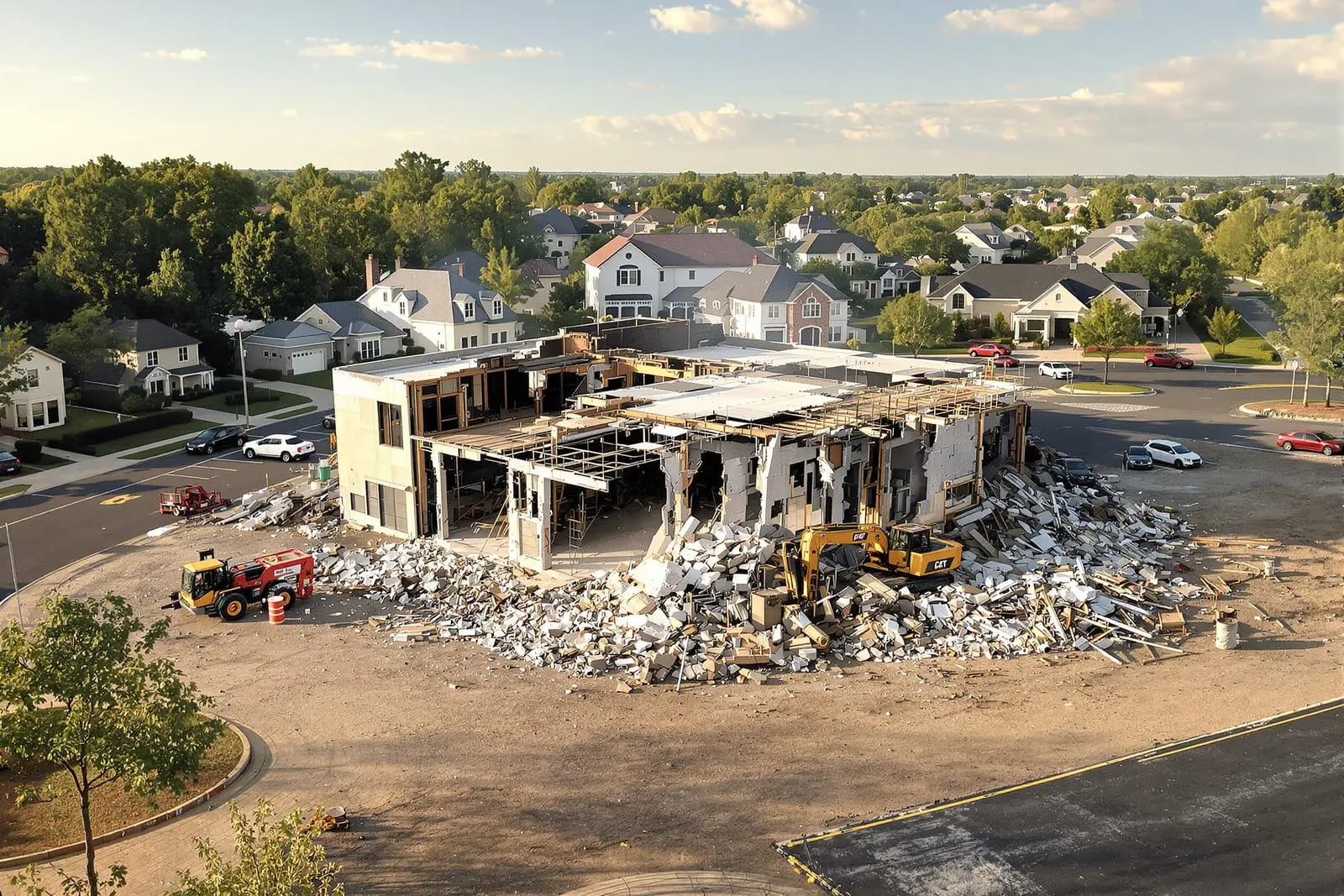
Wrexo Demolition Houston supports implosion demolition in Houston, TX for large structures that require controlled explosive techniques. Working with licensed blasting engineers, we plan charge placement, exclusion zones, and debris management. Our team manages pre blast prep and post blast cleanup so towers and heavy structures can be removed quickly and safely.
Wrexo Demolition Houston provides professional implosion demolition throughout Houston, TX and the surrounding area. Our licensed, insured crew delivers safe, clean, on-time work with a free estimate before anything begins. Call (832) 924-0400 or request your free quote.
Explosive and Implosion Demolition in Houston, TX
Explosive and implosion demolition is a precise engineering method, not simply “blowing up” a building. At Wrexo Demolition Houston, we use controlled charges and timing to make structures fold into themselves, staying within a predetermined footprint. This service is ideal for high‑rise buildings, parking garages, stadium seating, stacks, and industrial structures that are difficult or unsafe to dismantle with traditional equipment.
In Houston, explosive and implosion demolition often makes sense in dense areas where you cannot swing long-reach excavators safely or where internal structural damage makes manual work risky. We study the building’s load path so when charges are fired, columns and key connections fail in a planned sequence. The building loses support at specific points and gravity does the rest. The goal is to reduce height quickly, limit lateral movement, and keep debris inside a tight collapse zone.
Because of Houston’s mix of older concrete buildings, steel-framed offices, refineries, and port facilities, each implosion design is unique. Wrexo Demolition Houston evaluates whether explosives are even the right tool. In some cases, part of the structure may be imploded while attached components are taken down mechanically, especially near pipelines, active plants, or transit lines.
Our Method: How Wrexo Plans an Implosion Demolition
A successful implosion demolition in Houston starts with engineering, not explosives. First, Wrexo Demolition Houston completes a structural survey. We review original drawings when available, verify on site where load-bearing members actually are, and note modifications such as added mezzanines, retrofits, or fire damage. For refineries or chemical plants along the Ship Channel, we also analyze process histories, corrosion, and any hot work restrictions.
Next, we build a collapse model. Our team identifies which columns, shear walls, or braces must be cut or charged so the structure sinks inward. On concrete frames we may pre‑weaken specific columns using saw cuts or core drilling before loading charges. On steel frames we may remove some bolts, torch-cut selected beams, or add kickers and guy lines that steer the fall.
Charge design comes after the physical planning. For reinforced concrete, we commonly use linear or shaped charges that fracture rebar and concrete at the same time. For steel, we use cutting charges placed to sever flanges and webs. We calculate the size and number of charges for each member based on cross‑section, reinforcement, and stand‑off distance, then sequence them with electronic detonators so different floors or frames fail in a controlled order. The firing sequence might cascade from the center outward or from lower floors upward, depending on neighboring properties and wind conditions.
Finally, we perform test blasts when needed, especially on older Houston buildings where concrete strength or rebar details are uncertain. These small trial shots let us confirm how the structure reacts so we can fine‑tune charge weight and placement before the main event.
Permits, Safety, and Regulations in the Houston Area
Explosive and implosion demolition in Houston requires strict compliance with local, state, and federal rules. Wrexo Demolition Houston manages the permitting process so owners are not tangled in paperwork. For projects inside Houston city limits, we coordinate with the City of Houston Public Works, Houston Fire Department, and in some cases the Office of Emergency Management and local law enforcement. Outside the city, we work with county authorities and relevant special districts.
We obtain the necessary demolition permits, blasting permits, and road closure permissions if nearby streets or sidewalks must be cleared. Utilities are verified and disconnected or protected in cooperation with CenterPoint and any private service providers. When rail, pipelines, or port operations could be affected, we coordinate time windows and safety plans with their operators.
On every implosion demolition, we prepare a written blast plan and safety plan that covers exclusion zones, airblast limits, dust control, and debris containment. We notify neighbors, building management, local businesses, and in some cases schools or hospitals so they know exactly when the blast will occur and what to expect. For sensitive facilities such as data centers or labs, we can set conservative vibration limits and monitor in real time so equipment is protected.
Residents in Houston are often concerned about blast vibrations. We deploy seismographs at preset distances to document actual ground motion and keep it below industry standards and project-specific criteria. This documentation protects both the property owner and the community by showing the work was completed within safe thresholds.
Cost Factors for Implosion Demolition in Houston
No two implosion demolition projects in Houston cost the same, and pricing that looks cheap on paper can be risky if it leaves out critical steps. Wrexo Demolition Houston builds estimates around real-world conditions, not assumptions.
Key cost drivers include structural type and complexity. A simple concrete parking garage with clear spans and predictable columns is far less demanding than a hospital tower with irregular framing and retrofits. Higher complexity means more engineering hours, modeling, testing, and contingency planning.
Site constraints also impact cost. Downtown Houston parcels or properties near active businesses may require more extensive protection, scaffolding, netting, or pre‑demolition trimming of exterior features. If the collapse footprint must be extremely tight due to adjacent glass curtain walls or historic structures, charge design and pre‑weakening work will be more involved.
Environmental and abatement issues are another major factor. Any asbestos, lead-based paint, or regulated materials must be removed or safely managed before blast day. In industrial zones along the Ship Channel, we may need to handle residual product lines, contaminated soils, or process equipment, which adds time and cost but cannot be skipped.
Finally, community impacts influence budget. Night or weekend blasts to avoid rush-hour traffic, extended street closures, or additional security and crowd control all carry costs. We line-item these factors so Houston owners see exactly what they pay for, from engineering and explosives to hauling and final site grading.
Managing Risks: Dust, Debris, and Neighboring Properties
The most common concerns about implosion demolition are dust, flying debris, and damage to nearby buildings. Wrexo Demolition Houston addresses those issues directly in the design phase, not as an afterthought.
Dust control starts with pre‑wetting. Before an implosion, we may flood interior floors using hoses or sprinklers, then add exterior water curtains from hydrants or tankers positioned upwind. The goal is to trap dust as the structure collapses. We also study Houston’s prevailing wind patterns and time of day, then schedule the blast for conditions that keep dust away from sensitive properties whenever possible.
To limit debris travel, we often “wrap” the base of the structure and critical areas in heavy geotextile fabric, chain‑link panels, or timber shielding. Stairwells, ground‑level windows, and mechanical openings can be boarded or caged to keep fragments from exiting at high velocity. For especially tight urban sites, we may partially gut non-structural elements in advance to reduce loose items inside the building.
Protecting neighbors is a combination of engineering, communication, and physical safeguards. We conduct pre‑blast condition surveys of nearby structures, documenting existing cracks or issues with photos and written notes. This protects both you and adjacent owners by creating a clear baseline. During the blast, we keep exclusion zones larger than the predicted collapse area and post trained spotters and security at access points.
Noise and vibration are unavoidable, but they can be controlled. Blast sequencing, charge confinement, and reduced individual charge weights are all tools we use to keep vibrations within agreed limits. If your project is close to hospitals, transit lines, or critical utilities, we can phase work or use hybrid methods so only part of the structure is imploded while the rest is dismantled more quietly by machine.
What Houston Owners Should Know Before Choosing Implosion Demolition
Explosive and implosion demolition is not always the right option, even when it looks faster on video. Before you commit, Wrexo Demolition Houston walks you through whether implosion is the best technical and financial choice compared to conventional mechanical demolition.
First, consider your schedule and nearby operations. Implosion can reduce the actual tear‑down time to seconds, but the planning, permitting, and prep work may span weeks or months, especially inside the City of Houston or near refineries, transit lines, or schools. If you have flexibility in schedule, implosion can open the site sooner for construction. If your timeline is short but permitting is complex, a mechanical approach might be more realistic.
Second, look at surrounding properties and future site use. If you are clearing a downtown lot for a new high‑rise, minimizing damage to adjacent foundations, utilities, and streets is critical. In some cases, a controlled implosion that drops the structure neatly within its own footprint can actually reduce risk compared to months of mechanical work next to live sidewalks and traffic.
Third, factor in Houston’s climate. Summer heat, heavy rain, and hurricane season all affect planning. High winds or lightning risk can delay blast day, so we often recommend scheduling major implosions in late fall, winter, or early spring when weather is more stable and air quality conditions are better for dust management.
Finally, verify qualifications. For explosive and implosion demolition in the Houston area, you should expect detailed blast plans, proof of insurance that specifically covers explosive work, blasting licenses, and real project references, not just generic demolition experience. Wrexo Demolition Houston provides all of that up front, along with clear communication about risks, mitigation measures, and what success looks like on your specific site.
“
Professional explosive and implosion demolition, done right the first time, quality materials, honest pricing, and results that last.
Wrexo Demolition Houston
Explosive and Implosion Demolition Across Our Service Area