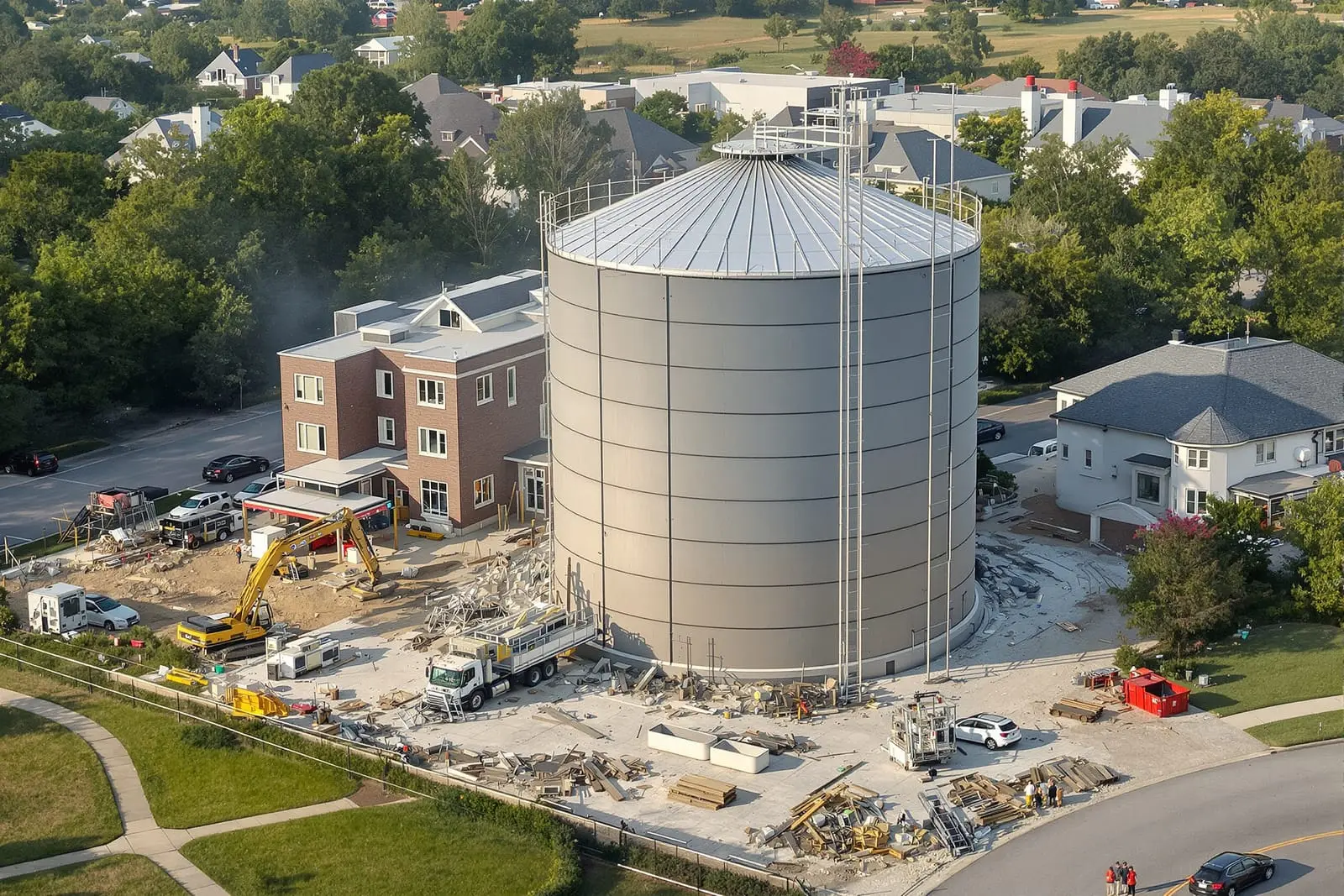
Wrexo Demolition Houston performs tank demolition in Houston, TX for industrial plants, terminals, and agricultural sites. We clean, cut, and dismantle above ground storage tanks, silos, and stacks using cranes, torches, and mechanical equipment. Our team focuses on fall direction, fire safety, and recycling of scrap metal for cost effective project delivery.
Wrexo Demolition Houston provides professional tank demolition throughout Houston, TX and the surrounding area. Our licensed, insured crew delivers safe, clean, on-time work with a free estimate before anything begins. Call (832) 924-0400 or request your free quote.
Specialized Tank, Silo and Stack Demolition in Houston
Tall industrial structures are a different animal than standard building tear downs. When you call Wrexo Demolition Houston for tank demolition or the removal of silos and stacks, you are dealing with a crew that handles vertical work every week in the Houston area.
We regularly remove petroleum and chemical tanks around the Ship Channel, grain and cement silos on the north and east sides, and concrete or steel stacks at older plants inside the Loop and in Pasadena, Deer Park, Baytown, and La Porte. Each structure is evaluated for its age, materials, prior contents, and proximity to live operations, power lines, and neighboring properties.
Our goal is simple: bring the structure down in a controlled, predictable way, keep your facility safe and operational as much as possible, and leave you with a clean pad that is ready for your next project or sale. From the first site visit through final haul off, you will know exactly what we are doing and why.
How Tank Demolition Actually Works
Tank demolition is heavily driven by what the tank held and how it was built. A fuel tank near the Ship Channel is very different from a potable water tank in a municipal yard. Wrexo Demolition Houston starts with a detailed site walk, review of existing drawings if available, and a discussion with your EHS or maintenance team about historical use.
Step 1 is isolation and cleaning. We confirm the tank is fully isolated from piping, pumps, and utilities, then coordinate cleaning and gas-free certification if required. For hydrocarbon or chemical service tanks, we often partner with local industrial cleaners to steam clean, rinse, and manage any sludge removal. We will not cut into a tank shell until it has been tested and cleared for hot work.
Step 2 is structural planning. We identify shell thickness, stiffeners, roof type (fixed cone, dome, or floating), and foundation style (ringwall, pile supported, or direct slab). Smaller tanks can often be dismantled with shear-equipped excavators from the top down. Larger field-erected tanks may require creating controlled openings at the base, then using mechanical pulling to lay the shell over in a predetermined direction.
Step 3 is controlled cutting and bracing. Our crew uses a combination of cold cutting, torch cutting, or saw cutting depending on residual hazards and access. When space is tight, we cut the tank into sections and lower them with cranes instead of tipping the entire structure.
Step 4 is processing and recycling. Houston has strong scrap markets, so we torch and shear steel into mill-acceptable sizes on site. This can significantly offset your project cost. Concrete ringwalls are broken, the rebar is separated, and both streams are removed or, if useful, left prepared for your next contractor.
Step 5 is final grading and proof rolling if requested. We do not leave you with a rough pile of rubble. We backfill voids from ringwalls or pits, compact the subgrade, and coordinate density testing if your engineer requires it.
Silo and Stack Removal, From Farm Yards to Refineries
Silos and stacks bring their own quirks. Around Houston, we see concrete grain silos, welded steel silos for cement and plastic pellets, and brick or reinforced concrete stacks at older boiler houses and refinery units. Wrexo Demolition Houston adapts methods to each structure.
For silos, a major question is access. Many grain and cement silos sit close together, with conveyors or bucket elevators tying groups of silos into one system. We often sequence demolition one silo at a time, bracing shared structures so you can keep neighboring silos in service if needed. Concrete silos may be tackled with high-reach excavators and hydraulic hammers, nibbling from the top while we manage dust and falling debris with exclusion zones.
Steel silos can often be stripped of equipment, then cut into vertical strips and folded inward so all material falls into the footprint of the silo. This technique is useful on tight industrial sites in the East End or near the Port, where property lines and live equipment are a few feet away.
Stacks require careful stability checks. Older brick stacks in Houston can hide internal cracking from decades of thermal cycling. We inspect with drones, manlifts, and, if needed, limited interior access to understand where to cut and where to brace. For short stacks, high reach machines with shears or hammers may be enough. For taller, heavily reinforced or guy-supported stacks, controlled mechanical felling or piece-by-piece crane work is safer.
Throughout, we control dust with water spray, schedule loud work around your operating windows, and coordinate road or rail protection if debris could affect public right of way. If there is an internal liner with asbestos-containing material, we bring in licensed abatement partners before any structural removal begins.
What Drives Cost and Timeline in Tank Demolition Projects
Two tank demolition projects can look identical from the road yet differ greatly in cost. Wrexo Demolition Houston is transparent about what affects your number so you can plan and budget accurately.
Contamination and cleaning are usually the biggest variables. A clean water tank with accessible drains is simple. A crude oil tank with sludge, internal floating roof, and questionable historical records requires more testing, cleaning, and paperwork. Expect higher costs where we need confined space entries, continuous air monitoring, or special waste profiling and disposal.
Access and working room also matter. A tank in a wide-open laydown yard can often be felled and processed quickly. The same size tank squeezed between an active process unit and a property fence will require craned sections, smaller equipment, and more labor hours. Overhead pipe racks, live power, and soft soils from Houston clays can all push us toward lighter equipment and more staging.
Height and construction affect method and schedule. Concrete silos with heavy rebar mats take longer to break and process than thin shell steel tanks. Brick stacks with unknown reinforcing must be taken down slower with more monitoring. If an engineer requires vibration limits due to sensitive neighboring structures or lab equipment, we will modify methods, for instance by using cutting instead of heavy impact.
Permitting and utility coordination can influence start date. Within Houston city limits, demolition notifications and utility disconnect verifications are required. If railroad spurs or TxDOT rights of way are nearby, we build in time for approvals and flagging. We handle this coordination for you, but it should be part of your planning. Our estimates break out line items so you can see where money is going and identify options to adjust scope if needed.
How Wrexo Demolition Houston Plans a Safe, Local Project
Before we touch a bolt, we create a project-specific plan. For tank, silo, and stack demolition, that plan includes site-specific safety analysis, detailed demolition sequence, equipment selection, and an emergency response outline tailored to your facility and your neighbors.
We start with a kickoff meeting that includes your operations, safety, and maintenance stakeholders. We walk the Houston weather reality into the schedule, including summer heat stress controls, lightning procedures for tall structures, and contingency days for heavy rain that can turn clay subgrades to mud. Our crews are trained to work under refinery and plant rules, including TWIC, ISNetworld, and site-specific orientations.
Neighbors and community issues are also part of planning within the metro area. If you are near residential areas in the Heights, East End, or along older industrial corridors, we design the work to minimize noise and dust and can provide you with simple talking points for nearby businesses or property owners. For rural sites on the outskirts, access roads and ground-bearing capacity for heavy haul trucks may be bigger concerns, so we survey ahead of time.
During demolition, we maintain a clear chain of communication. You will have direct contact with a project manager and superintendent who are actually on site, not a call center. Daily progress updates and photos are available so you always know what has been completed and what is next. At closeout, we provide waste manifests, scrap tickets if applicable, and a concise summary of what was removed and how the site was left, which is especially valuable for corporate records or future property transactions.
“
Professional tank, silo and stack demolition, done right the first time, quality materials, honest pricing, and results that last.
Wrexo Demolition Houston
Tank, Silo and Stack Demolition Across Our Service Area